A platform to create football betting systems based on BIG DATA. The ability to back test strategy ideas against a huge database, containing in excess of 100,000 matches across 111 of the top leagues & covering the most common football betting markets. A solution built for seamless automation, with direct integration into your Betfair trading software. Combined with access to hundreds of ready made public strategies, Betaminic provides a complete package for data analysis, strategy development, bet placement & results tracking.
The Betaminic Service
This service allows you to transform betting ideas, the kind that often sit at the back of your mind, into fully automated strategies. For example, you might wonder whether it’s profitable over the long term to back Over 2.5 Goals in matches where both teams have scored at least three goals across their previous three games. With Betaminic, you can back test that idea and see exactly what profit or loss it would have produced had you been using it over the past decade.
Likewise, if you believe favourites are consistently overpriced in a particular league, you can analyse the performance of backing them across ten years of historical data. All of this is achieved using the Betaminic Builder, a powerful tool designed for creating and testing custom betting systems against its database.
Once you’ve identified a strategy that performs well, you can save it, connect your Betaminic account to your Betfair software, and automate the process. From there, it’s simply a matter of monitoring results as the system runs in the real world over time. In addition to custom system creation, Betaminic also offers a selection of ready-to-use public strategies. These are profitable systems shared by other users, which you can subscribe to and run immediately.
Ultimately, Betaminic encourages a more analytical approach to betting, helping you identify value through data and use the efficiency of automation.
Getting Started…
The Betaminic Builder is a fully web-based platform, meaning there’s nothing to install on your local machine. The image below illustrates the layout of the tool, along with the results from a randomly selected public strategy. The left-hand panel allows you to configure a wide range of variables covering many aspects of football. These include, for example, league selection, odds ranges, and various team performance streaks. There are many additional criteria available, offering significant flexibility when testing strategy ideas. Each time a variable is added or adjusted, the platform instantly recalculates the results and displays on the right-hand side.
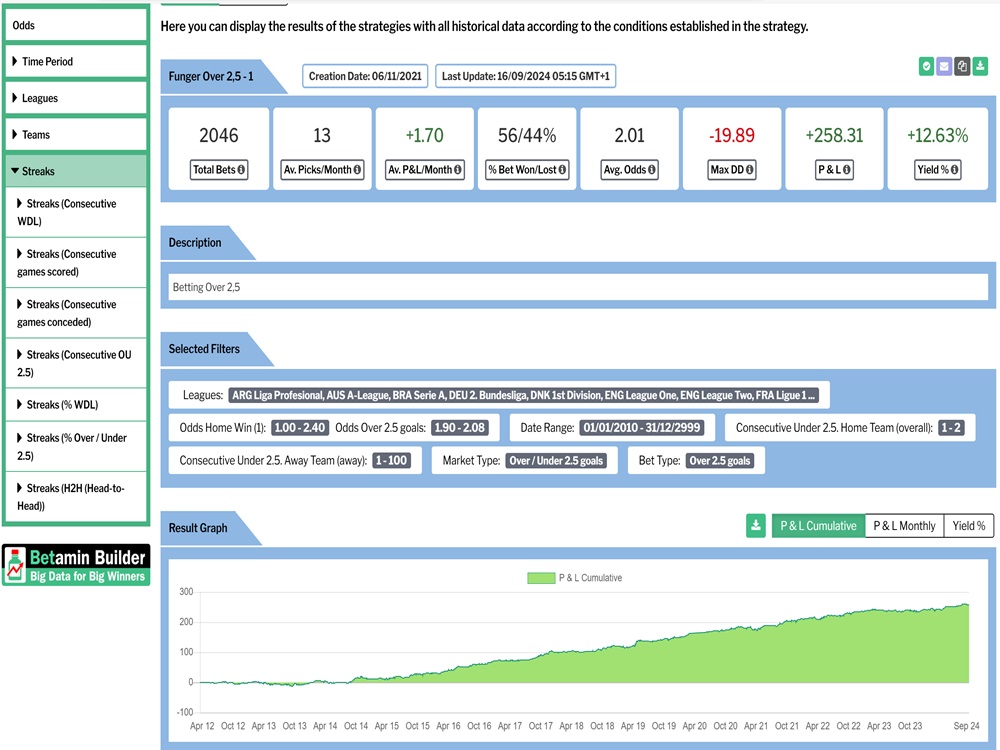
The platform provides a range of key performance metrics, including profit and loss, average monthly bet volume, average odds, and maximum drawdown. The maximum drawdown figure is particularly valuable, as it highlights the worst historical losing run a system has experienced and helps you size your betting bank appropriately to reduce the risk of running out of funds.
Performance is also visualised through clear P&L graphs, allowing you to assess how a system has performed over time. While past results can never guarantee future profits, it’s always preferable to base decisions on data and evidence rather than intuition alone.
Another good feature is the System Aggregator. The principle of not putting all your eggs in one basket is always a good thing, and this tool allows you to view combined performance metrics across multiple systems. For example, if you run five custom strategies alongside three public systems, the aggregator will display the overall P&L, maximum drawdown, and other key statistics across the entire portfolio. Using multiple systems with relatively low drawdowns should, in theory, help smooth results and reduce the number of losing months.
Importantly, all of these features are available for free. You only begin paying when you choose to receive system selections ahead of kick-off.
We believe it is important to fully understand anything you are putting you money into rather than going in blind & on first use of the Betamin Builder it was somewhat confusing how odds were being calculated/used. The system results screen shows both Opening Odds & closing odds. We reached out to the Betaminic team by email for and explanation. This was the detailed response received…
“The opening odds are the odds available when the bookmaker first releases them. Some bookmakers release these odds up to a week before the event, while others wait until closer to kick-off. These odds can change quickly, so it’s not always guaranteed that you’ll be able to place a bet at the opening odds.
The closing odds are the final odds available just before the event starts. At Betaminic, we use the closing odds from Pinnacle because they are considered highly reliable and are widely available. These closing odds can also be easily verified on Pinnacle’s site or on other sportsbooks and betting exchanges with similar pricing.
Here’s how this works in our system: Opening odds are used to find bet selections and apply the filters in a strategy. Closing odds are used to calculate the results of those strategies, ensuring realistic profit calculations and transparency. The odds you select in your strategy filters correspond to the opening odds, while the average odds displayed in the results are based on the closing odds from Pinnacle.“
Top marks for the early support! To summarise, selections are found based on initial bookmaker bookmaker prices & results P&Ls are calculated from Pinnacle closing lines. This is positive & suggests that advised odds should be achievable on Betfair.
Service Pricing & Membership Packages
As outlined above, you can use the Betaminic Builder to create and test your own strategies completely free of charge by simply opening an account. This is an ideal way to familiarise yourself with the platform and explore its capabilities before committing any money. The limitation of the free access is that you won’t receive advance notifications of the selections your systems generate. To run a strategy in the real-world, whether manually or through automation, a paid subscription is required.
There are currently two pricing tiers available, which we’ll outline below…
- 7 Day – 100 Picks @ €29.90
- 30 Day – 1000 Picks @ €29.90
A few important points to be aware of. Betaminic subscriptions do not renew automatically. If you purchase a 30-day membership, your access will end once that period expires. Any unused picks will be lost unless you renew before your membership end date. If you do renew in time, any remaining picks will be carried over into your new subscription. It’s also worth noting that if you operate multiple systems and use all of your allocated picks within a single month, you’ll need to purchase an additional package to continue receiving selections.
Exchange Trial
As the strategy results for this service are based on Pinnacle prices, we don’t anticipate major issues in achieving comparable odds on Betfair. The key question this trial aims to answer is whether following the historical trends identified by the service can deliver long-term profitability. While past performance can never guarantee future results, for Betaminic to be considered a viable product it must, at the very least, consistently guide betting decisions in the right direction.
Given the wide range of public strategies available on the platform, these provide a sufficient testing ground without the need to create our own systems. That said, there is the risk that popular strategies may suffer from price compression as more users follow them. To properly test this theory, we’ll be tracking 20 public strategies, spanning a variety of market types:
- 5 × Draw
- 5 × Match Win
- 5 × Asian Handicap (+0.5)
- 5 × Over/Under 2.5 Goals
Each strategy has been carefully selected using two key criteria. First, every system must be backed by at least 2,000 historical bets, ensuring the results are statistically meaningful rather than the product of short-term variance. Second, the cumulative P&L graph must show a clear upward trajectory, helping us avoid systems that performed well early on but are now in decline.
We’ll follow all 20 systems simultaneously, with all bets placed automatically using the BF Bot Manager integration. For bank and staking management, we’ll allocate a combined bank of £2,000, staking £10 per selection (0.5% of the initial bank). The Betaminic Aggregator too suggests the max draw down of the combined system set is 166 points & so 200 points should ensure that we stay in the game for the duration of the trial. The trial will continue until the total number of bets placed across all systems reaches 1,000, at which point we’ll review and assess the results.
Betaminic Review – Results
**Update: After completing the initial 1,000 bets, we have decided to extend the trial by a further 1,000 selections for several reasons. Many of the systems included operate at odds above 3.5, and several of these currently have relatively small sample sizes. Higher-odds strategies require a larger dataset to properly validate or disprove long-term performance. In addition, the Draw System set produces a number of duplicate selections, which can amplify variance during losing runs. While December saw a significant drawdown, results throughout 2026 have shown a steady upward trend. We will therefore continue tracking performance for a further 1,000 bets before conducting the next review.
Our selected portfolio of Betaminic public strategies has now passed the 2,000-bet mark, covering the period from December 2025 through to September 2026. We now have a substantial sample of real-world exchange data to assess how these strategies have performed outside of their historical back-testing results.
To recap, our system selection process was based on a number of criteria. We wanted to create a diverse portfolio covering a range of markets, including Match Wins, Draws, Over/Under Goals and Asian Handicap.
Each strategy also had to meet a minimum 5% ROI across its full historical dataset, while demonstrating a consistently upward trend in its cumulative P&L graph within the Betaminic Builder. This helped us avoid selecting systems that had generated strong historical returns but were showing signs of deteriorating performance.
Finally, selection frequency was an important consideration. We wanted strategies that generated a regular flow of bets, as a system producing only a couple of selections each month would provide limited value for an exchange trial.

The 2,190 bets generated a loss of -£706.33, reducing our £2,000 starting bank by 35.32%. Although this is not where we had hoped to be at this stage, the outcome of the trial was unfortunately shaped by its first month, December 2025.
The -£847.25 loss recorded over the festive period put us on the back foot from the outset. Had the trial started one month later, it would have finished in profit. The graph below illustrates our progress throughout the trial period.
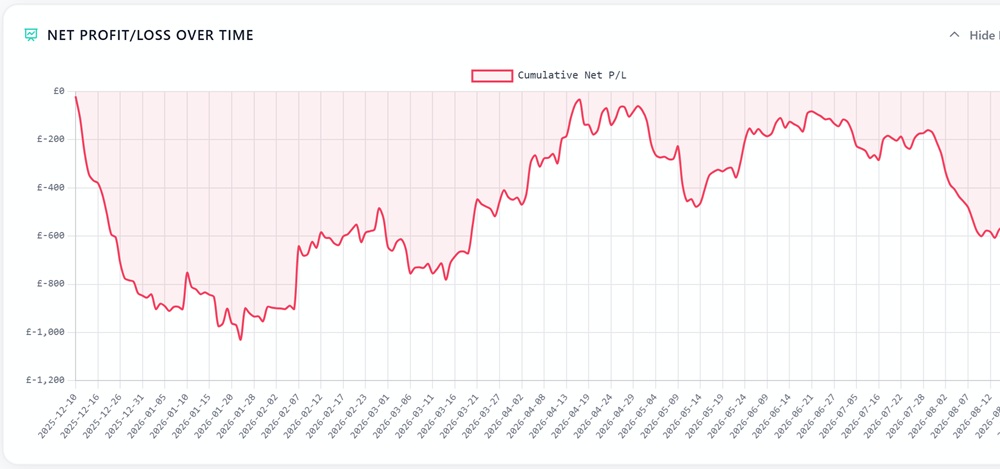
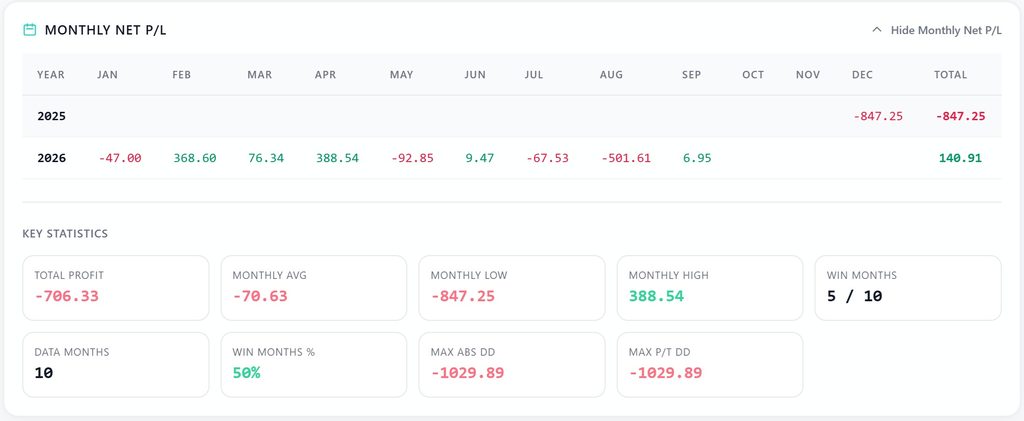
Let’s take a closer look at the statistics from the trial shown below.
Exactly 50% of the trial months were profitable, but unfortunately, the losses recorded in December 2025 and August 2026 significantly outweighed the larger winning months.
The maximum drawdown during the trial was £1,029.89, equivalent to 102.99 points. This represents more than half of our allocated £2,000 starting bank, highlighting the level of volatility experienced throughout the trial.
As our results were below expectations, we revisited the Betamin Builder to see whether the platform had recorded a similar downturn during the trial period.
As discussed earlier, the Betamin Builder includes an Aggregator tool that allows multiple public strategies to be combined, providing consolidated performance statistics and charts.
Below is the aggregated output for all of the public systems we selected for the trial, with our exchange trial period highlighted by the red box. Interestingly, Betaminic did record a very similar downturn to our own results, including a substantial loss of around 86 points in December. This close correlation gives us confidence that the results recorded by Betaminic are consistent with the performance of the underlying strategies and that the data appears to be legitimate.
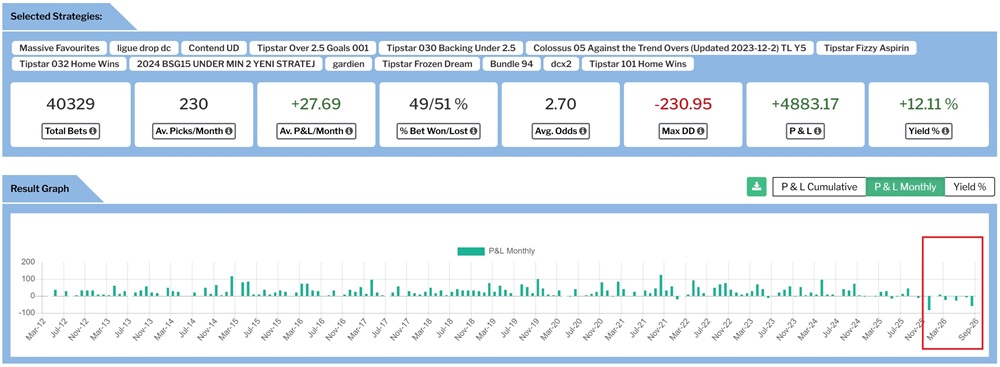
The poor run during the trial period is particularly interesting. Looking at the chart, there are relatively few losing months compared with the number of strong winning months, making the period highlighted by the red box look noticeably different from the rest of the historical performance.
It is also worth noting the maximum drawdown figure provided by the Aggregator for the combined systems: -230.95 points.
This puts our own maximum drawdown of -102.99 points into perspective. Although our drawdown felt significant at the time, it represents less than half of the worst drawdown experienced across the combined systems over their full history. Given the 40,329 bets recorded, drawdowns of a similar magnitude to ours have likely occurred multiple times before, with the systems subsequently recovering and continuing to grow.
That said, the period highlighted by the red box does look visually different from much of the historical data. This raises an interesting question as to whether we are simply experiencing another normal drawdown or whether there has been a more recent change in the underlying performance trend.
Individual Public Strategy Performance
Now lets take a look at the performance of each selected Betaminic public strategy and also the groupings we assigned. This should highlight what performed well & whether there were any specific problem areas. The table below shows individual statistics for each strategy followed and the performance of each group.
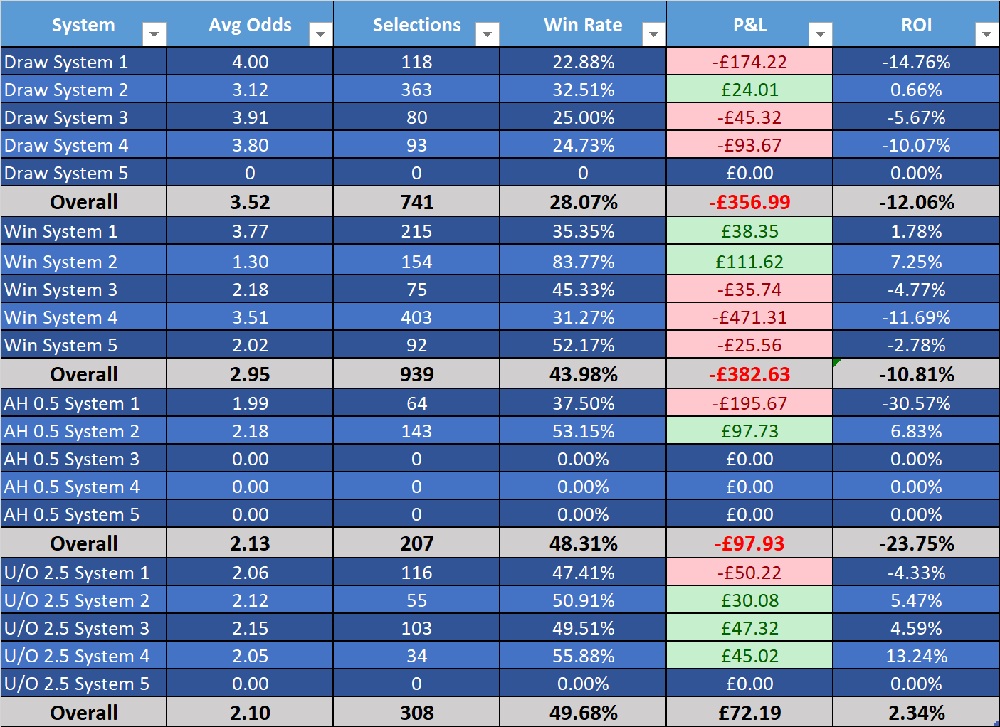
The first thing to highlight is that five of the strategies recorded no bets during the trial period. We checked each of these strategies in the Betamin Builder and confirmed that they were producing selections. Our automation configuration was also correct, so we are currently unsure why these bets were not placed. This does not affect the overall trial results, but it does reduce our active strategy set from 20 to 15.
The second point worth discussing is the impact of Win System 4. This system produced the most bets by some distance, with 403 selections, and recorded a loss of -£471.31. Removing this one system alone would have significantly changed the overall outcome of the trial. I think this highlights an important point when following any betting system, or collection of systems: performance should be monitored regularly, ideally at least monthly. A system should always be given a substantial sample of bets before making any decisions, but there can be warning signs that a previously successful trend is changing.
Looking at Win System 4 in the Betaminic Builder, there is a clear downturn in the P&L trend that has not appeared previously in the system’s history. Another factor worth considering is that the system currently appears to be at, or very close to, its maximum historical drawdown. These could be signs that the system should be removed from live betting and placed into a monitoring portfolio. Betaminic is very much built around a set-and-forget, automation-focused approach, but our experience demonstrates the importance of continuing to monitor system performance.
Draw Systems
The Draw system set produced 741 bets and an overall loss of -£356.99 (-35.69 points). Of all our system groups, the Draw strategies produced the highest average odds at 3.52. They accounted for approximately 34% of all bets placed, but around 51% of the overall loss. It is also important to note that the Draw systems produced a high volume of duplicate bets. This means that any run of form, whether positive or negative, will be amplified across the portfolio.
Win Systems
The Win system set produced 939 bets and an overall loss of -£382.63 (-38.26 points). These systems were a mixture of average odds, with three producing average prices of 2.18 or below and two incorporating higher-priced outsiders. As already discussed, the Win set contained the single worst-performing system in the entire trial by some distance. Had that system been removed, the overall Win portfolio would have produced a much more respectable return.
Asian Handicap +0.5 Systems
The Asian Handicap +0.5 system set produced 207 bets and an overall loss of -£97.93 (-9.79 points). Unfortunately, only two of the five systems produced any bets during the review period. We have investigated why this happened but have been unable to identify the cause. The other systems were producing selections within the Betamin Builder but they were not being sent to our BF Bot Manager instance. The two systems that did operate were something of a double-edged sword. One performed very well, while the other produced the worst ROI across all of the systems. In this situation, it would be worth analysing the selection criteria of the two systems in more detail to understand what caused such a significant difference in performance. That said, the sample size for this system group is very small, so we should be cautious about drawing firm conclusions.
Under/Over 2.5 Goals Systems
The Under/Over 2.5 Goals system set produced 308 bets and an overall profit of £72.19 (7.22 points). We had another system that failed to fire in this group, but three of the remaining four systems finished in profit. This was another group featuring relatively low average odds. Under/Over 2.5 System 4 was the best-performing individual system across the entire trial in terms of ROI, although it was based on a very small sample. Interestingly, we appear to have had greater success with the shorter-priced systems, something we will explore further.
Betaminic Exchange Trial – Final Thoughts
The concept behind Betaminic is certainly appealing. With automation at the heart of the service, the prospect of generating betting profits simply by leaving software running is an attractive one. You can browse a large selection of historically profitable strategies, subscribe to the ones that appeal to you and then sit back while your computer places the bets around the clock. After more than 2,000 bets, however, our experience suggests that it is not quite that simple.
We carefully selected strategies from a range of market types, looking for systems with clear upward P&L trajectories, strong historical data and a minimum level of proven profitability. Despite this, the combined portfolio lost more than 70 points over our 10-month review period. Of the 16 strategies that actually placed bets, only seven finished in profit. This means that, despite all of the selected systems showing positive performance in recent historical data, nine went on to lose money during 2026.
I am also curious about the way Betaminic classifies and identifies selections. As discussed earlier in the review, the Betamin Builder stores the first prices made available by bookmakers, often up to a week before an event takes place. Strategies then use these prices to identify potential selections, which are subsequently placed at closing odds. There is always the possibility that an individual bookmaker could significantly misprice a team. For example, a bookmaker might initially price a team at 4.00, while the closing market eventually settles around 2.20. The next five bookmakers to release prices a day later might all offer something around 2.20. That initial bookmaker error could therefore influence the Betaminic strategy selection, even though the price was never realistically available at the time the bet was ultimately placed. That said, Betaminic’s results are based on Pinnacle closing lines, which are widely available and provide a useful benchmark.
So, is all hope lost for Betaminic?
I don’t think so. However, I do think you need to be selective with your strategy choices and be prepared to spend time monitoring their performance, adding and removing systems as the data develops. Although our trial produced a significant loss, much of the damage was done during the very first month, December 2025. Had we started the trial just one month later, we would now be discussing a profitable trial and the returns generated during the following nine months. It is also reassuring to see the Betamin Aggregator showing results for our selected systems that closely align with the real-world results we recorded. This gives us confidence that our trial data is a genuine reflection of the underlying systems.
There is also the possibility that our review simply coincided with an unusually poor period for the selected strategies and that the combined portfolio will recover in due course. With more than 2,000 bets, however, we have still generated a meaningful sample from which to draw conclusions. One of the challenges of maintaining a large portfolio of strategies over the long term is the cost. At €99.90 per month, the strategies need to generate a sufficient return simply to cover the subscription costs before you begin making a genuine profit.
I do think there is money to be made with Betaminic, but I would approach it differently.
My approach would be to select a larger number of strategies and initially monitor them with real bets, staking the minimum £1 per selection. Once an individual strategy has built up a minimum sample, say 200 bets, and is showing a positive return with a strong ROI, you could then consider increasing the stake on that strategy alone. As the sample size grows and the strategy continues to generate profits, stakes could potentially be increased further.
At the same time, your real-world data should be monitored continuously. If a strategy that has been promoted to a higher staking level begins to decline, revisit its Betamin Builder charts and assess whether the results represent a temporary downturn or whether the underlying trend has genuinely changed. While Betaminic automates the placement of bets, this is really where the work comes in.
It is also worth noting that the shorter-priced systems performed better during our trial. The combined systems with average odds of 2.50 or below produced a small profit of £24.58 and if this was an out of the norm negative spell, they survived it. These strategies will generally experience lower drawdowns, so they could potentially provide a more sensible starting point.
You should approach Betaminic in much the same way as an investment portfolio. Use a sufficiently large bank, keep individual stakes relatively small and give your systems enough time to prove themselves over a substantial sample. Remember that although our maximum drawdown was -102.99 points, the Betamin Aggregator shows that the combined strategies have historically experienced a drawdown of more than twice this figure.
Overall, Betaminic is an enjoyable platform, highly transparent and backed by good support. If you are prepared to put in some time and effort, and approach it with a long-term mindset, I believe there is potentially money to be made. Based on what we have learned from this trial, we are now going to test a selection of shorter-priced Betaminic systems and will update this review once we have accumulated sufficient data.